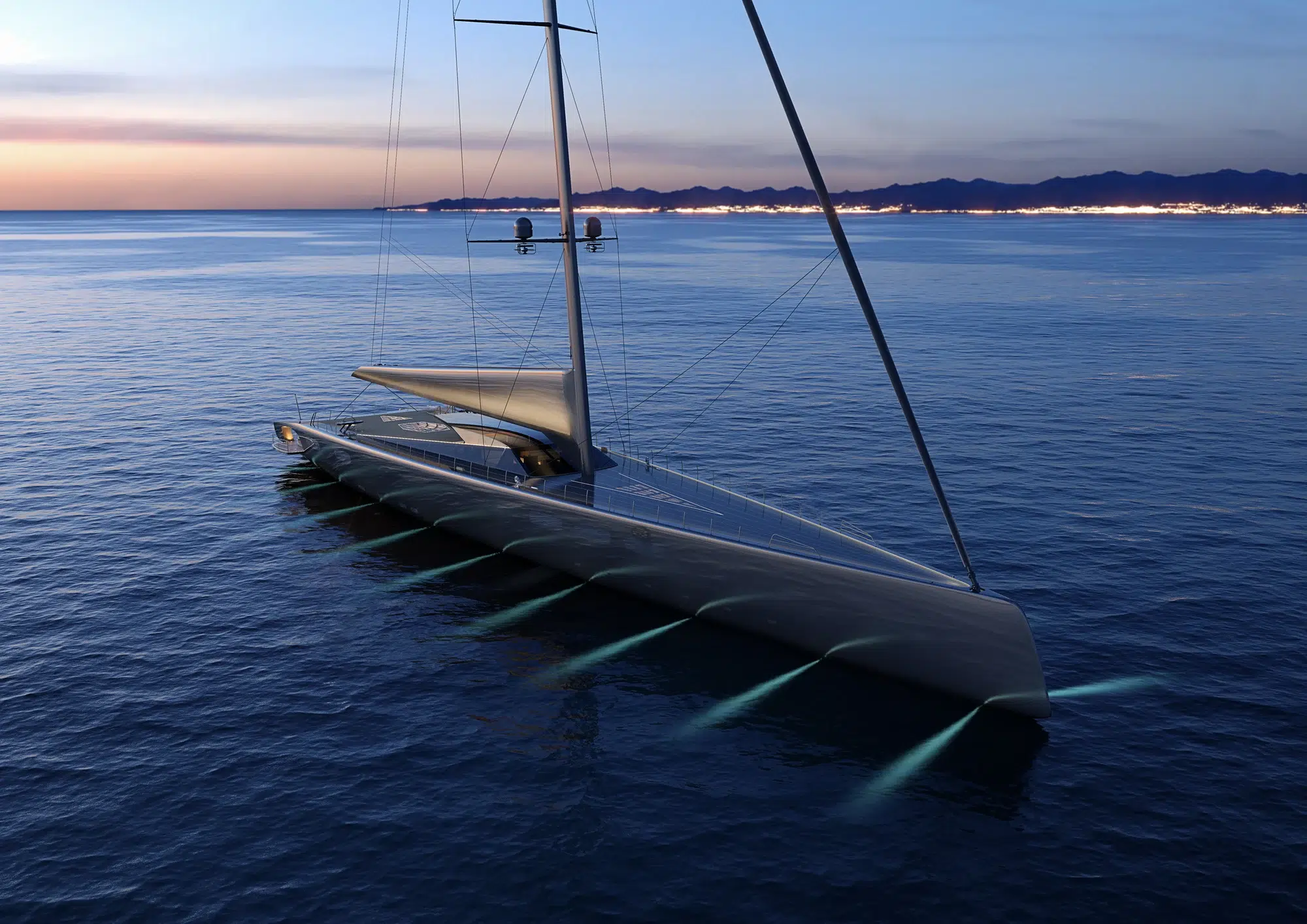
At 85 meters, Royal Huisman’s Project 410 is impossible to discuss without first acknowledging the number. When launched, the 280-foot yacht will become the world’s largest sloop-rigged sailing yacht and one of the ten largest sailing yachts afloat. Yet reducing the project to a record would miss the more consequential achievement taking shape in Vollenhove. Project 410 has been conceived not simply as an enormous yacht with a single mast, but as a genuine sailor’s yacht—one intended to preserve the sensation, efficiency, and responsiveness of sailing at a scale where those qualities can easily disappear.
That ambition has guided the project from the beginning. Frers Design is responsible for the overall concept, exterior styling, and naval architecture, while London-based Wetzels Brown created the interiors. Royal Huisman’s brief was unusually exacting: the yacht had to deliver the safety, comfort, privacy, and luxury expected of a contemporary megayacht while remaining ready to sail within minutes and rewarding enough to perform convincingly even in light airs.
The challenge is not merely one of size. It is one of preserving character.
Frers began with a hull form capable of accommodating two full interior levels around a single mast while keeping the deckhouse relatively restrained. The resulting profile is long, low, and unusually clean, with pure deck lines that form what designer Mani Frers describes as a single arrow from bow to stern. A raked mast and specially engineered boom reinforce the sense of forward movement, while the yacht’s comparatively high freeboards provide privacy and protection without making the exterior feel ponderous.
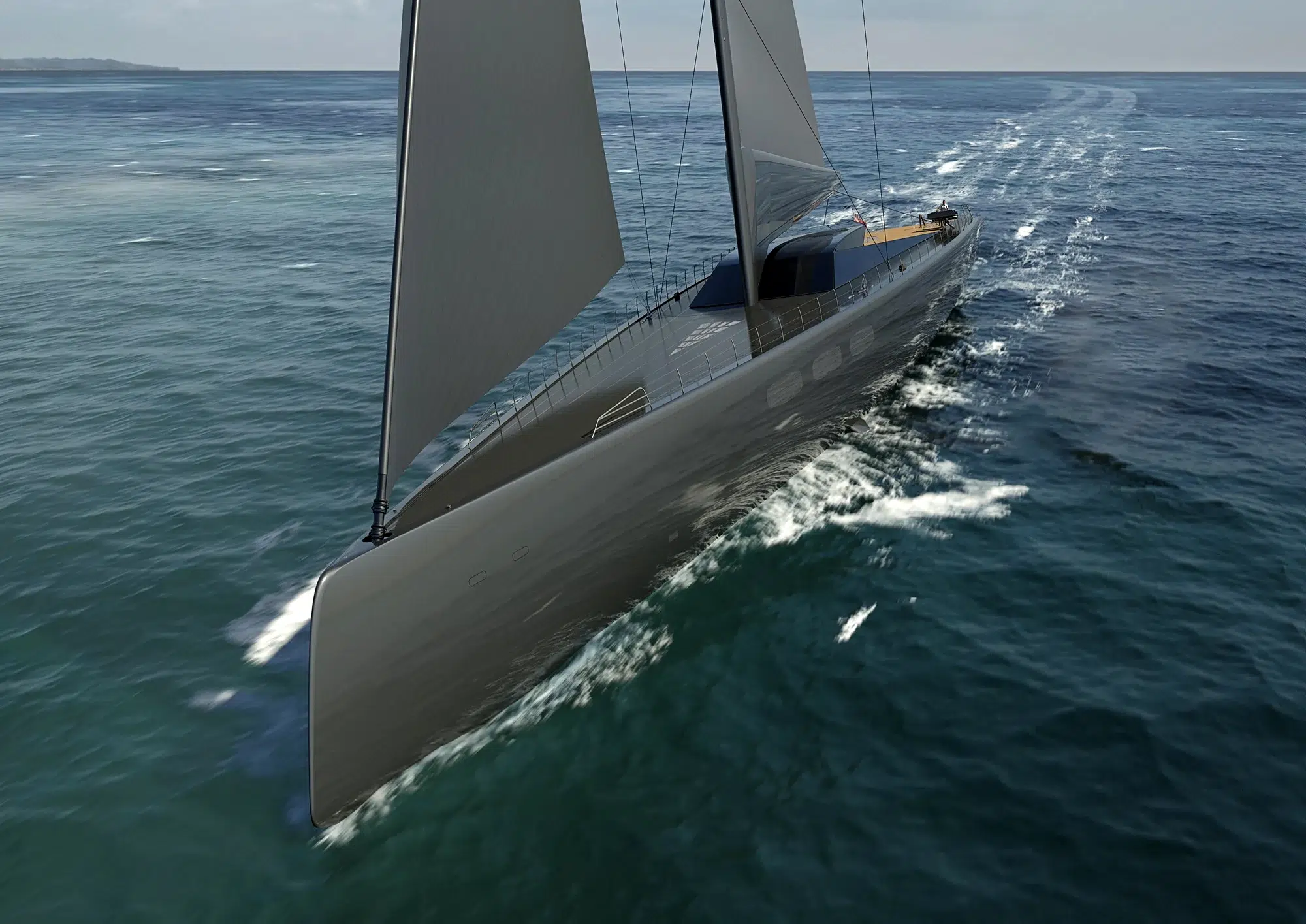
The naval architecture is equally purposeful. Project 410 combines low draft with high stability, allowing her to access a broader range of destinations while sailing at relatively low heel angles. That matters on a yacht intended not merely to cross oceans but to make those passages enjoyable. Royal Huisman has repeatedly emphasized that the long waterline and rig are designed to produce meaningful sailing performance even when the breeze is modest, allowing the yacht to build apparent wind rather than waiting passively for ideal conditions.
Perhaps more interesting still is the fact that the yacht was effectively designed from the inside out. Wetzels Brown began by shaping the interior experience and the relationship between guests and the sea before working with Frers Design to resolve the yacht’s exterior architecture. It is an unconventional sequence for a project of this scale, and one that helps explain why the interior feels less like accommodation inserted into a hull and more like an environment around which the yacht was conceived.
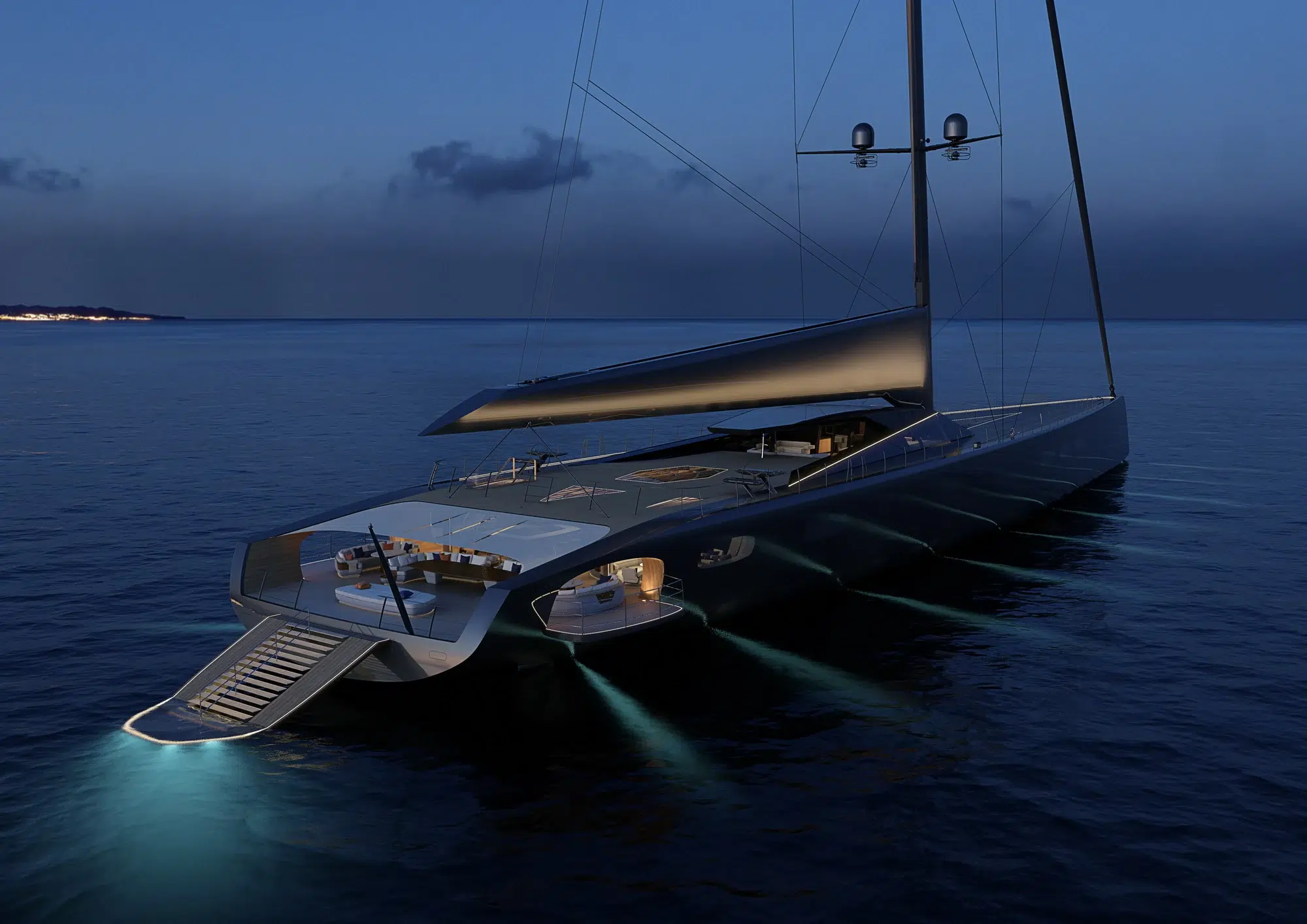
Large hull windows draw the horizon into the interior, while skylights and generous ceiling heights introduce constantly changing daylight. The principal living spaces are arranged on a single level within the hull, creating an unusually fluid progression through the yacht. A double-height entrance leads toward the main salon, while aft, a veranda transitions naturally into the beach club, linking enclosed space, shaded deck, sunlight, and water in one continuous sequence. Forward, the layout becomes progressively more private as it approaches the owner’s suite.
The effect is less nautical formality than a contemporary retreat. Wetzels Brown has described the objective as creating an environment in which people can relax, remain close to the sea, and make memories, with the exterior, interior, and act of sailing treated as one continuous experience rather than three separate design exercises. That philosophy feels particularly important on a yacht this large, where scale can so easily overwhelm intimacy.
Project 410’s engineering is no less ambitious. Royal Huisman’s sister company Rondal is responsible for the yacht’s carbon mast, boom, and integrated sailing system, bringing together specialist rig engineering and shipyard expertise at a scale few builders have attempted. The aluminum hull was constructed at Royal Huisman’s Vollenhove facilities, where the shipyard extended one of its production halls specifically to accommodate the project.
The scale of that construction became particularly clear during the hull-turning operation in 2024. A 61-meter section of the aluminum hull was rolled out of the hall and lifted by four cranes over the adjacent canal before being rotated upright and returned to the facility for continued outfitting. The operation was less a piece of maritime theater than a reminder that Project 410 required the shipyard itself to think differently about how a sailing yacht of this magnitude could be built.
Yet the yacht’s most forward-looking work may be hidden well below deck.
Project 410 incorporates energy regeneration while sailing, a large-capacity battery system, quiet operation, and the ability to run in silent mode. Royal Huisman has previously disclosed that the yacht’s hybrid architecture includes a two-megawatt battery bank designed to support silent, fumeless propulsion as well as extensive hotel loads at anchor. The aim is not simply to reduce fuel consumption but to use sailing itself as part of the yacht’s energy strategy.
That approach builds on experience Royal Huisman has been developing for nearly two decades. The yard points to Ethereal, launched in 2008, as the world’s first hybrid superyacht and an early proving ground for the technologies now being refined on much larger platforms. Project 410 takes those principles into a different category entirely, combining free wind propulsion, energy regeneration, battery storage, and quiet operation within one of the largest sailing yachts ever created.
It is important not to confuse those advances with environmental absolution. An 85-meter superyacht remains a complex, resource-intensive object. What Project 410 demonstrates instead is how a sailing platform can use scale more intelligently, relying on wind not as decorative heritage but as a genuine source of propulsion and energy.
That distinction separates the yacht from much of the contemporary megayacht conversation.
Luxury at the very top end of the market has often been defined by insulation from the environment: more interior volume, more climate control, more systems, and a greater sense of separation from wind, spray, and motion. Project 410 proposes the opposite idea. Its extraordinary scale is used not to retreat from sailing, but to enlarge the experience of it.
The yacht’s single mast may dominate the skyline, but the real measure of success will be found lower down: in how quickly she can transition from anchorage to sailing mode, how she behaves in light air, how quietly she can operate under battery power, and whether a vessel of 85 meters can still give the person at the helm the sense that the yacht is alive beneath them.
That is the question Royal Huisman appears determined to answer.
The project is now entering its final stage of completion in Vollenhove following its public unveiling at the 2026 Monaco Yacht Show. Royal Huisman describes the yacht as the culmination of vision, scale, and innovation, but notably, the shipyard continues to frame performance and the pleasure of sailing as the central objective rather than the record itself.
That restraint feels appropriate, because records in yachting rarely remain records forever. Another yacht will eventually be longer. Another mast may rise higher. Another project will claim a new superlative.
Project 410’s more enduring significance may lie elsewhere: in proving that a yacht can reach extraordinary dimensions without surrendering the essential qualities that make sailing compelling in the first place. At 85 meters, that may be the most ambitious luxury of all.