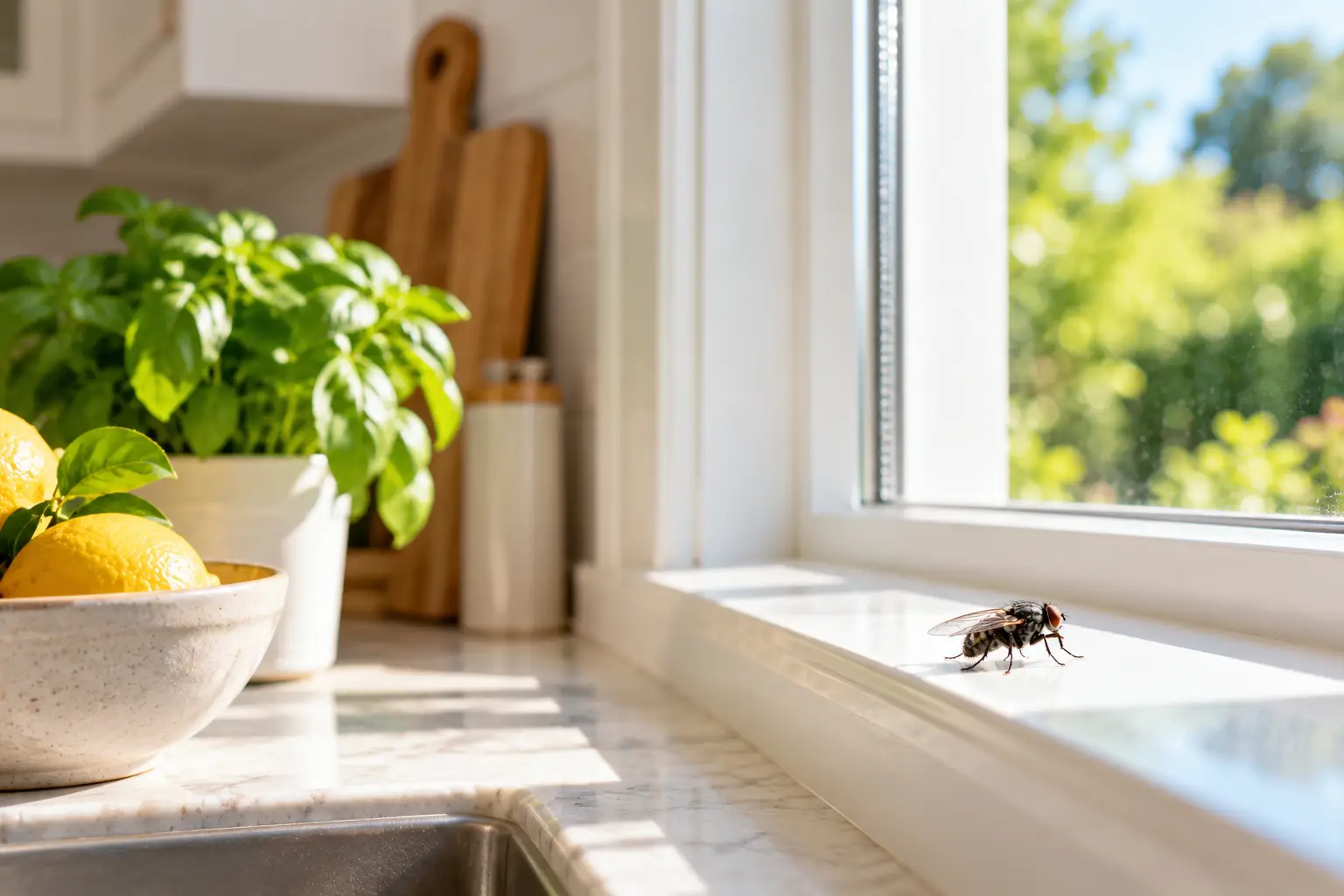
If you have ever watched a house fly buzzing around your kitchen, you may have wondered: how big do house flies get? These tiny insects can feel much larger when they are circling your food, landing on windows, or darting around the room. In reality, house flies are small, but their speed, movement, and constant presence make them very noticeable.
Adult house flies are usually around 6 to 7 millimetres long, which is roughly a quarter of an inch. Females are often slightly larger than males, and pest experts note that female house flies are usually bigger than male house flies. While that may sound tiny, a house fly’s body structure, wide vision, and fast flight make it one of the most familiar pests found in homes.
What Does a House Fly Look Like?
A typical house fly has a greyish body, a single pair of wings, and large red compound eyes. These compound eyes contain thousands of tiny lenses, helping the fly see movement from many directions. This is one reason house flies are so difficult to swat.
Their bodies are also slightly hairy, and they have only one pair of wings. Unlike bees or wasps, house flies do not have a stinger, and they do not bite with teeth because they do not have teeth. Instead, they feed by using a sponge-like mouthpart to take in liquid or softened food.
Are Female House Flies Bigger Than Males?
Yes, female house flies are generally a little larger than males. The size difference is not dramatic, so most people will not notice it without close inspection. However, females need extra body capacity for egg production, which is one reason they tend to be slightly bigger.
This is also why seeing several flies indoors can quickly become a bigger issue. A single female house fly can lay eggs in suitable organic matter, and those eggs can develop rapidly in warm conditions.
How Big Are House Fly Eggs and Larvae?
House fly eggs are very small and are often described as looking like tiny grains of rice. After hatching, the larvae, commonly called maggots, grow to about 7 to 10 millimetres long, or around ¼ to ⅜ of an inch. Interestingly, mature maggots can be similar in length to adult flies, although they look completely different.
Maggots are pale, soft-bodied, and legless. They are usually found in decaying food, rubbish bins, compost, animal waste, or other damp organic material. If you notice maggots, it usually means flies have found a place to breed nearby.
Why Do House Flies Look Bigger Indoors?
House flies may only be a few millimetres long, but they often seem bigger inside a home because they move quickly and erratically. Their wings make a loud buzzing sound in quiet rooms, and their sudden movements attract attention. A fly on a window, wall, or kitchen counter can feel more intrusive than its actual size suggests.
Lighting also plays a role. When flies gather near bright windows or lamps, their shadows and reflections can make them appear larger.
Can House Flies Grow Larger Than Normal?
Most house flies stay within the usual small size range. If you see a fly that appears much bigger, it may not be a house fly at all. It could be a cluster fly, blow fly, bluebottle, or another species. These flies can look similar at a quick glance but may be larger, shinier, or slower-moving.
The environment can affect fly development, but house flies do not keep growing after becoming adults. Once they leave the pupal stage, their adult size is fixed.
Why Size Matters in Fly Control
Knowing how big house flies get helps you identify the pest and choose the right control method. Since house flies are small, they can enter homes through tiny gaps, open windows, loose screens, and doors left open for only a few seconds.
To reduce house flies indoors, keep food covered, clean spills quickly, empty bins regularly, and remove anything that may attract them. Pay special attention to kitchen waste, pet food, drains, and compost containers.
Conclusion
So, how big do house flies get? Most adult house flies are only about 6 to 7 millimetres long, while their larvae can reach around 7 to 10 millimetres. They may be small, but their fast movement, wide vision, and ability to breed in waste make them a common household nuisance.
For more practical ideas on creating a cleaner, more comfortable, and better-designed living space, you can also explore Home Comfort Experts at https://homecomfortexperts.co.uk/. The website shares helpful inspiration for home design, home decor, and home improvement ideas, making it a useful resource for homeowners who want a stylish, comfortable, and well-maintained home.