To look into a Wallace Chan gemstone is to discover that its surface cannot be trusted. A face carved at the back of a transparent stone appears to multiply within it, suspended in light as though the gem contains several dimensions at once. The effect is ethereal, but the method behind it is anything but accidental.
Chan calls the technique the Wallace Cut. Invented in 1987, it combines reverse carving, precise faceting, three-dimensional intaglio, and mathematical calculation to transform a single carved image into multiple reflections. Conventional tools were inadequate, so Chan modified dental drills and worked with the stone submerged in water, protecting it from the heat and tension that could cause irreversible damage.
That instinct—to confront a material, discover its limitations, and then invent a new language for it—has defined Chan’s career. He began as a gemstone-carving apprentice at 16 and developed without the traditional education or inherited workshop lineage that often frames the world of high jewelry. His classroom was the material itself: crystal, jade, titanium, porcelain, and light.
The distinction matters because Chan does not design jewelry in the conventional sense and then search for techniques capable of producing it. Like other artists guided by a stone-first approach to high jewelry, he allows the character and limitations of the material to shape the creative direction, although his creations frequently begin with a technical impossibility. A gemstone should appear unsupported. A metal should carry enormous sculptural volume without becoming oppressive on the body. Porcelain should possess the strength to hold important stones rather than remain a fragile decorative accent.
His answers have repeatedly expanded the vocabulary of contemporary jewelry.
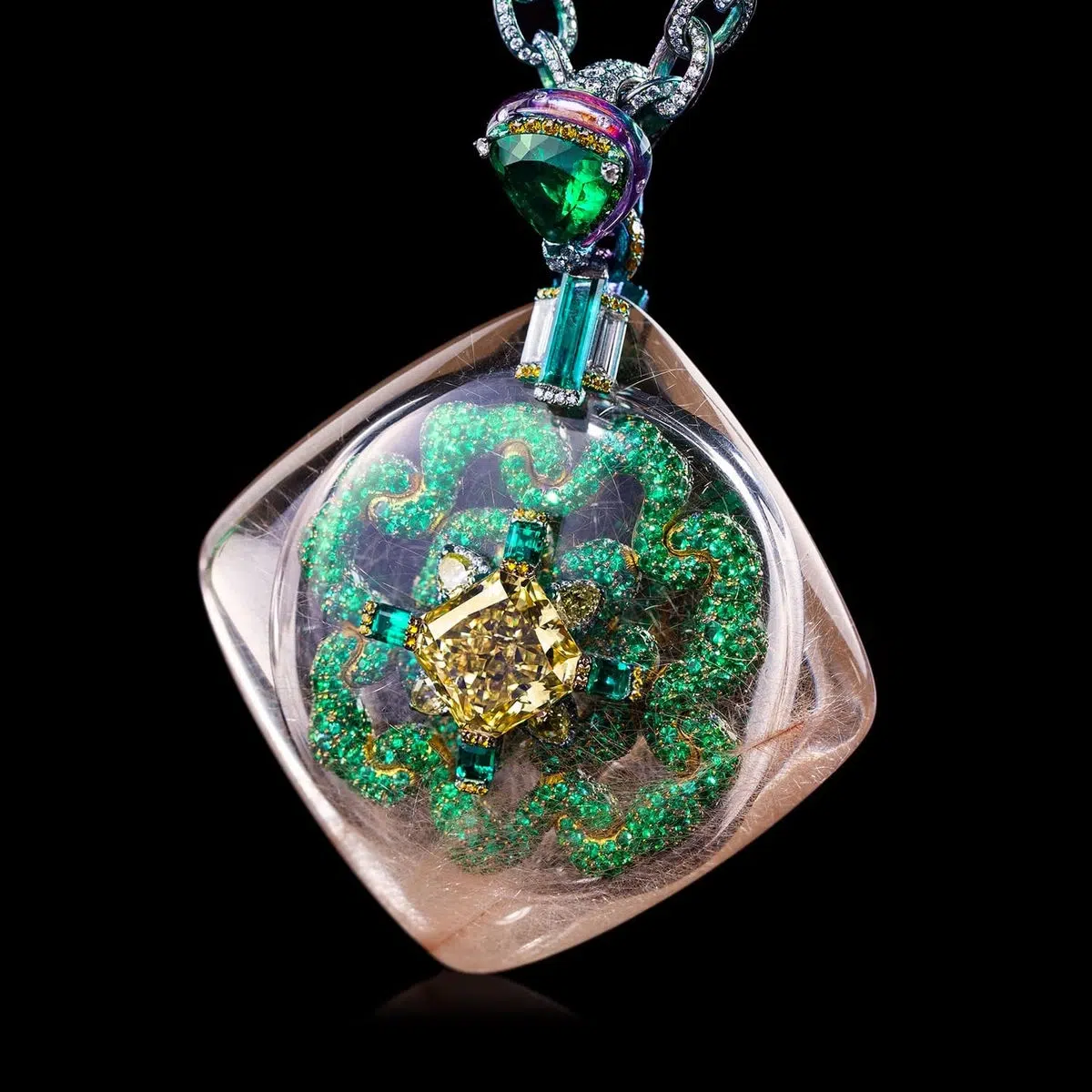
With the Wallace Cut, he turned the interior of a gemstone into a stage for illusion. In later setting innovations, he sought to remove the familiar metal claws that interrupt the view of a stone. One method uses diamonds and other gems as structural claws; another adapts the mortise-and-tenon logic of classical Chinese furniture, cutting stones so that they interlock without conventional metal settings. The jewelry appears lighter, yet the apparent effortlessness conceals exacting geometry.
Titanium gave Chan an even larger canvas. He spent eight years researching the metal before presenting his mastery of it in jewelry in 2007. Strong, hypoallergenic, and approximately one-fifth the weight of gold by equal volume, titanium allowed him to construct dramatic, gem-laden forms that could still be worn with surprising ease.
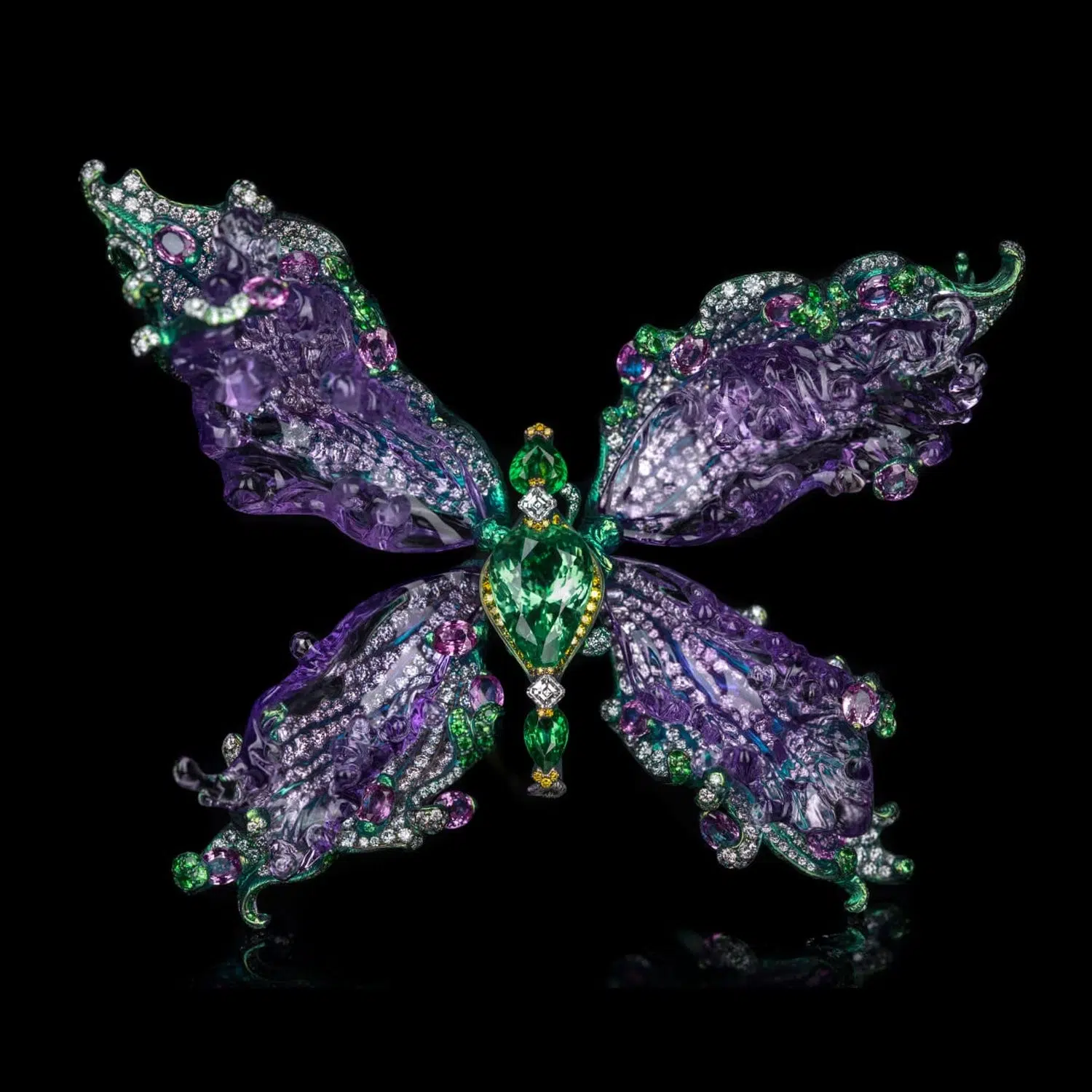
In Chan’s hands, titanium does not resemble an austere industrial material. It may become the wing of a butterfly, the body of an insect, a cloud, a flower, or an elaborate framework carrying stones of extraordinary color. Through controlled oxidation and finishing, he draws vivid blues, purples, greens, and golds from the metal, using the setting itself to deepen the surrounding gems rather than compete with them.
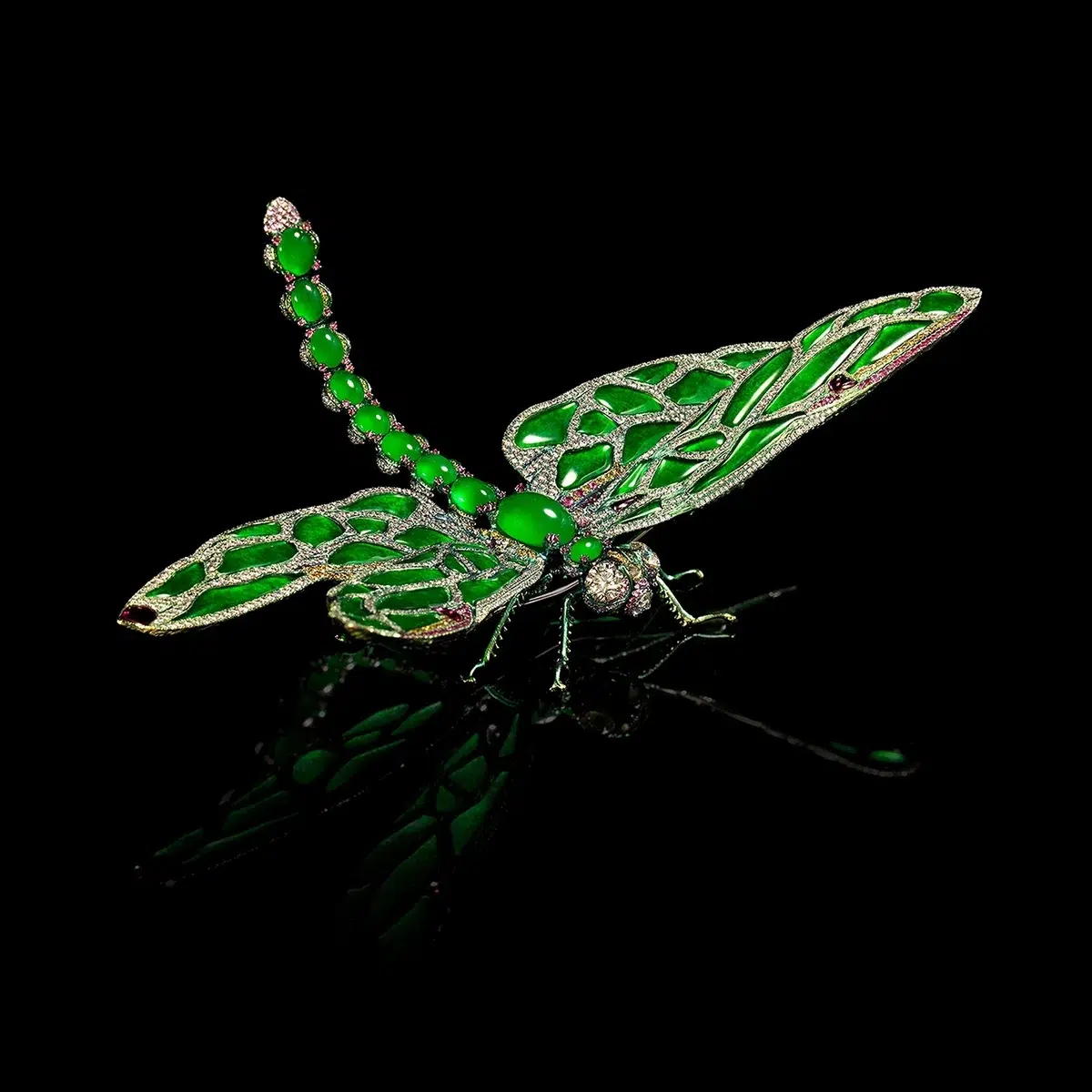
The work often begins in nature but rarely ends in realism. Like the finest expressions of nature-inspired high jewelry, butterflies appear caught between flight and transformation, flowers unfold with an almost supernatural symmetry, and marine forms seem discovered rather than fabricated. The imagery may be lyrical, but the pieces remain feats of engineering, their hidden systems enabling movement, transformation, and multiple ways of being worn.

Chan’s appetite for difficult materials eventually returned him to a childhood memory: a porcelain spoon falling and shattering. He spent seven years developing what became known as the Wallace Chan Porcelain, a lustrous contemporary material described by the artist’s studio as five times stronger than steel. Its first jewelry creation, the 2018 ring A New Generation, combines porcelain with titanium, sapphire, aquamarine, and diamond and entered the British Museum’s permanent collection in 2019.
His work now resides in institutional collections including the British Museum, the Victoria and Albert Museum, the Museum of Fine Arts, Boston, and the Shanghai Museum. That recognition places his creations in a realm beyond ornament, where they can be considered alongside sculpture, material research, and contemporary art.
Still, no discussion of Chan’s scale of ambition is complete without A Heritage in Bloom. Unveiled in 2015 for Chow Tai Fook, the elaborate necklace was built around 24 D-color, internally flawless diamonds cut from the 507.55-carat Cullinan Heritage rough. Its stones include a 104-carat round brilliant, surrounded by thousands of additional diamonds in a composition inspired by Chinese floral and cultural motifs.
Reportedly requiring more than 47,000 hours of work, the jewel can be transformed into numerous configurations and was widely valued at approximately $200 million when introduced. Yet its meaning cannot be reduced to price. Its deeper achievement lies in Chan’s ability to unite an entire family of diamonds from one historic rough within a single, highly adaptable work.
The necklace may be monumental, but Chan’s true signature remains the disappearance of difficulty. Metal seems to dissolve, gemstones float, and large creations rest on the body with an improbable lightness. The engineering is present everywhere, yet it rarely asks to be admired separately from the poetry it enables.
That is where Wallace Chan occupies his own territory. He does not treat science as the opposite of beauty, nor craftsmanship as a servant to design. In his world, invention is the path through which beauty becomes possible.
The jewel is never merely the final object. It is evidence that a limit has been reconsidered—and, with patience, altered.